


Current reads and discussions on topics relevant to our lives as research and scholarly writers.
- book club is open to all at CSU who wish to dig deep by reading and talking about issues relevant to research and scholarly productivity
- we feature books selected for their relevance to researchers and scholarly writers
- we consider topics are current and relate to issues of writing and research productivity, science communication, healthful academic work and life, and more.
FALL 2026 BOOK CLUB
open to all at CSU
PAST BOOK CLUBS
SPRING 2026 - Book Club
For the 2025-2026 academic year, CSU Writes’ Book Club invited campus-wide discussion on our evolving use of AI through two thought-provoking selections.
Co-Intelligence (Fall 2025) and The AI Con (Spring 2026) offer diverse perspectives to help us engage more purposefully and critically with AI in our work as academics, researchers, and lifelong learners. Please join us (in person or virtually) for a high-value conversation.
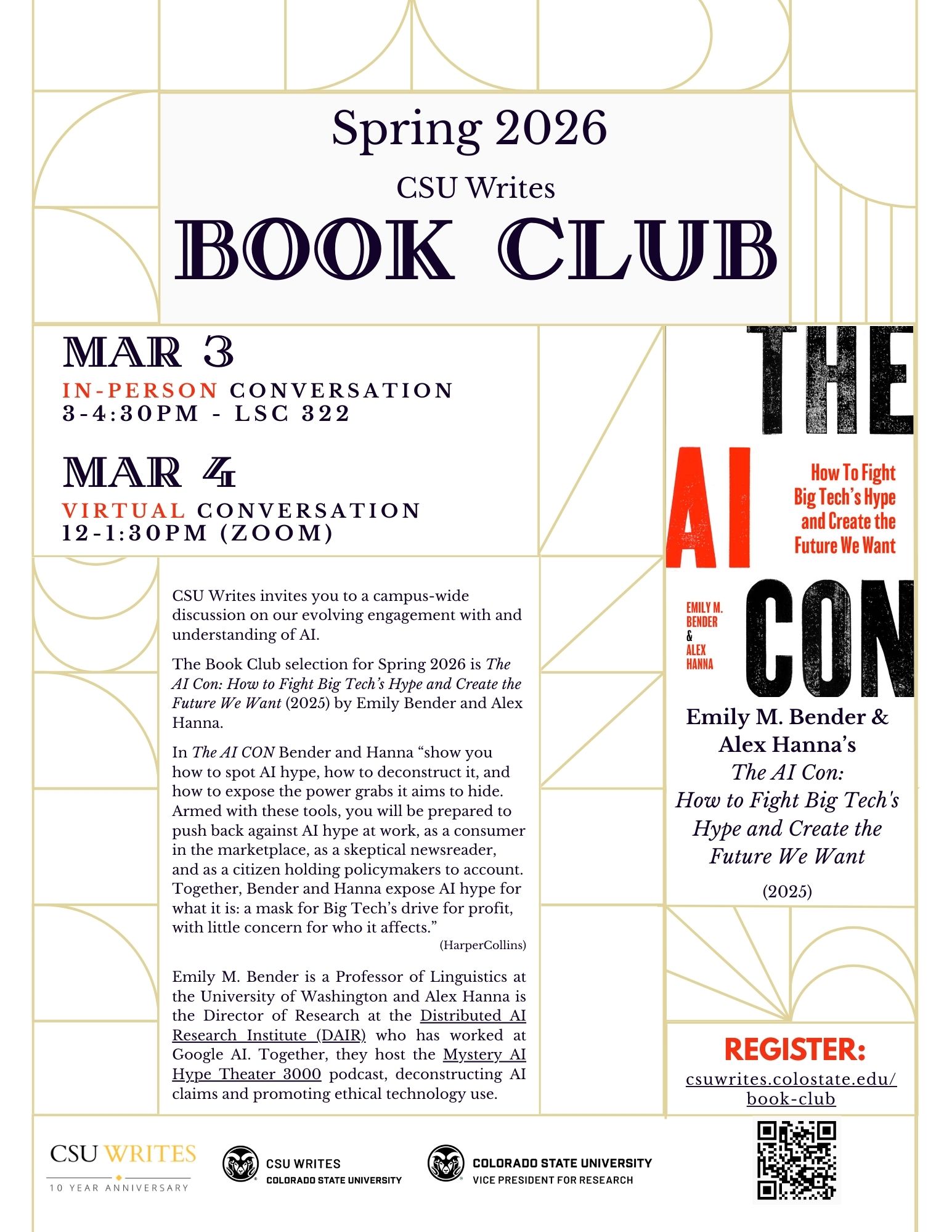
The AI Con: How to Fight Big Tech's Hype and Create the Future We Want (2025)
MARCH 3, 3-4:30pm, LSC 322
In-Person Conversation
MARCH 4, 12-1:30pm, Zoom
Virtual Conversation
A smart, incisive look at the technologies sold as artificial intelligence, the drawbacks and pitfalls of technology sold under this banner, and why it’s crucial to recognize the many ways in which AI hype covers for a small set of power-hungry actors at work and in the world.
Is artificial intelligence going to take over the world? Have big tech scientists created an artificial lifeform that can think on its own? Is it going to put authors, artists, and others out of business? Are we about to enter an age where computers are better than humans at everything?
The answer to these questions, linguist Emily M. Bender and sociologist Alex Hanna make clear, is “no,” “they wish,” “LOL,” and “definitely not.” This kind of thinking is a symptom of a phenomenon known as “AI hype.” Hype looks and smells fishy: It twists words and helps the rich get richer by justifying data theft, motivating surveillance capitalism, and devaluing human creativity in order to replace meaningful work with jobs that treat people like machines. In The AI Con, Bender and Hanna offer a sharp, witty, and wide-ranging take-down of AI hype across its many forms.
Bender and Hanna show you how to spot AI hype, how to deconstruct it, and how to expose the power grabs it aims to hide. Armed with these tools, you will be prepared to push back against AI hype at work, as a consumer in the marketplace, as a skeptical newsreader, and as a citizen holding policymakers to account. Together, Bender and Hanna expose AI hype for what it is: a mask for Big Tech’s drive for profit, with little concern for who it affects. (Harper Collins)
FALL 2025 - Book Club
CO-INTELLIGENCE: LIVING AND WORKING WITH AI (2025)
NOV 5, 3-4:30pm, LSC 322
In-Person Conversation
NOV 6, 12-1:30pm, Zoom
Virtual Conversation
From Wharton professor and author of the popular One Useful Thing Substack newsletter Ethan Mollick comes the definitive playbook for working, learning, and living in the new age of AI.
Something new entered our world in November 2022 — the first general purpose AI that could pass for a human and do the kinds of creative, innovative work that only humans could do previously. Wharton professor Ethan Mollick immediately understood what ChatGPT meant: after millions of years on our own, humans had developed a kind of co-intelligence that could augment, or even replace, human thinking. Through his writing, speaking, and teaching, Mollick has become one of the most prominent and provocative explainers of AI, focusing on the practical aspects of how these new tools for thought can transform our world.
In Co-Intelligence, Mollick urges us to engage with AI as co-worker, co-teacher, and coach. He assesses its profound impact on business and education, using dozens of real-time examples of AI in action. Co-Intelligence shows what it means to think and work together with smart machines, and why it’s imperative that we master that skill.
Mollick challenges us to utilize AI’s enormous power without losing our identity, to learn from it without being misled, and to harness its gifts to create a better human future. Wide ranging, hugely thought-provoking, optimistic, and lucid, Co-Intelligence reveals the promise and power of this new era.


SPRING 2025 - Book Club
MAR 12, 3-4:30pm| HYBRID: LSC 308-10 and Zoom
From the New York Times bestselling author of Digital Minimalism and Deep Work, a groundbreaking philosophy for pursuing meaningful accomplishment while avoiding overload.
According to Cal Newport, our current definition of “productivity” is broken. It pushes us to treat busyness as a proxy for useful effort, leading to impossibly lengthy task lists and ceaseless meetings. We’re overwhelmed by all we have to do and on the edge of burnout, left to decide between giving into soul-sapping hustle culture or rejecting ambition altogether. But are these really our only choices?
Long before the arrival of pinging inboxes and clogged schedules, history’s most creative and impactful philosophers, scientists, artists, and writers mastered the art of producing valuable work with staying power. In this timely and provocative book, Cal Newport harnesses the wisdom of these traditional knowledge workers to radically transform our modern jobs. Drawing from deep research on the habits and mindsets of a varied cast of storied thinkers – from Galileo and Isaac Newton, to Jane Austen and Georgia O’Keefe – Newport lays out the key principles of “slow productivity,” a more sustainable alternative to the aimless overwhelm that defines our current moment. Combining cultural criticism with systematic pragmatism, Newport deconstructs the absurdities inherent in standard notions of productivity, and then provides step-by-step advice for cultivating a slower, more humane alternative.
From the aggressive rethinking of workload management, to introducing seasonal variation, to shifting your performance toward long-term quality, Slow Productivity provides a roadmap for escaping overload and arriving instead at a more timeless approach to pursuing meaningful accomplishment. The world of work is due for a new revolution. Slow productivity is exactly what we need.

FALL 2024 - Book Club
NOV 4, 3-4:30pm| HYBRID: LSC 322 and Zoom
In his groundbreaking #1 bestseller Emotional Intelligence, Daniel Goleman revolutionized how we think about intelligence. Now, he reveals practical methods for using these inner resources to more readily enter an optimal state of high performance and satisfaction while avoiding burnout.
There are moments when we achieve peak performance: An athlete plays a perfect game; a business has a quarter with once-in-a-lifetime profits. But these moments are often elusive, and for every amazing day, we may have a hundred ordinary and even unsatisfying days. Fulfillment doesn’t come from isolated peak experiences, but rather from many consistent good days. So how do we sustain performance, while avoiding burnout and maintaining balance?
In Optimal, Daniel Goleman and Cary Cherniss reveal how emotional intelligence can help us have a great day, any day. They explain how to set a realistic, attainable goal of feeling satisfied that you’ve had a productive day — to consistently work at your ‘optimal’ level. Based on research of how hundreds of people build the inner architecture of having a good day, they sketch what an optimal state feels like, and show how emotional intelligence holds the key to our best performance.
Optimal is the culmination of decades of scientific discoveries bearing on emotional intelligence. Enhanced emotional intelligence pays off in improved engagement, productivity, and more satisfying days. In this book, you’ll find the keys to competence in emotional intelligence, and practical methods for applying this skill set more readily. It will equip you to become a highly effective leader and enable you to build an organizational culture that empowers workers to sustain high performance.
from HARPER COLLINS promo webpage

SPRING 2024 - Book Club/Short Course
MAR 26, APR 9, APR 23 | 1-2:30pm | HYBRID: LSC 308-310 and Zoom
Sönke Aherns, How to Take Smart Notes: One Simple Technique to Boost Writing, Learning and Thinking (2022)
Part book club, part training and practice session, this series of three workshops (short course) introduces writers to a reading and notetaking system that will enhance their writing quality and establish a system by which they can build (or continue to build) their research and scholarly careers.
Over 6 weeks and 3 discussion sessions, we will read and work with ideas from Sönke Aherns, How to Take Smart Notes: One Simple Technique to Boost Writing, Learning and Thinking (2022).
You can purchase a copy of the book at Sönke Aherns’ website or your preferred online book outlet.
For students, postdocs, or faculty who have need, CSU Writes has 10 copies of Ahern’s book. Request book here. If you register for this short course and request a book, we kindly ask that you attend all three discussion sessions (3/26, 4/9, 4/23).
About How to Take Smart Notes: “The key to good and efficient writing lies in the intelligent organisation of ideas and notes. This book helps students, academics and nonfiction writers to get more done, write intelligent texts and learn for the long run. It teaches you how to take smart notes and ensure they bring you and your projects forward. Instead of wasting your time searching for notes, quotes or references, you can focus on what really counts: thinking, understanding and developing new ideas in writing. It does not matter if you prefer taking notes with pen and paper or on a computer, be it Windows, Mac or Linux”…or other software systems such as Obsidian.

SPRING 2023
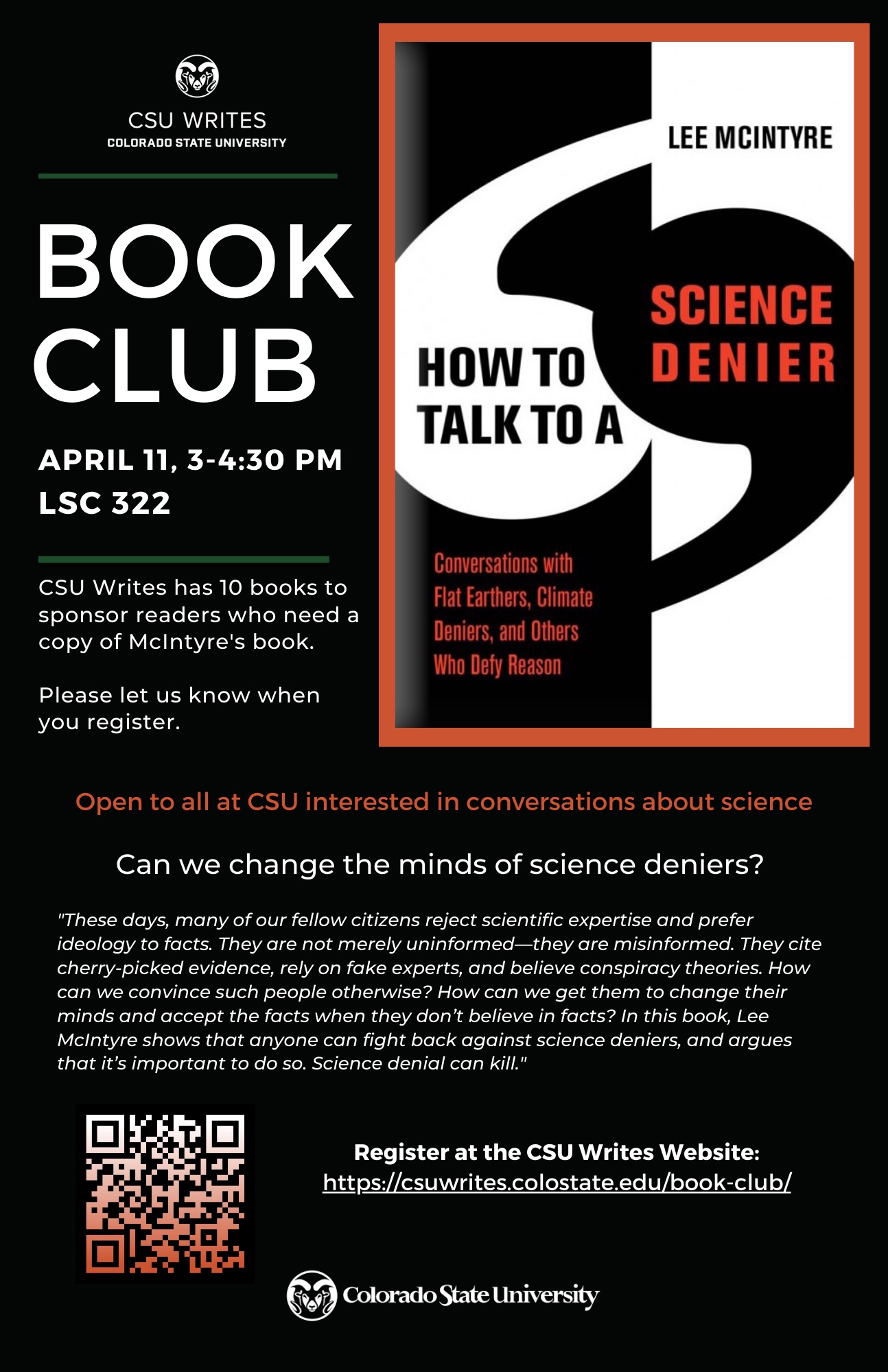
April 11 3-4:30 PM MST LSC 322
Lee McIntyre, HOW TO TALK TO A SCIENCE DENIER: Conversations with Flat Earthers, Climate Deniers, and Others Who Defy Reason (2022)
Can we change the minds of science deniers? Encounters with flat earthers, anti-vaxxers, coronavirus truthers, and others.
“Climate change is a hoax—and so is coronavirus.” “Vaccines are bad for you.” These days, many of our fellow citizens reject scientific expertise and prefer ideology to facts. They are not merely uninformed—they are misinformed. They cite cherry-picked evidence, rely on fake experts, and believe conspiracy theories. How can we convince such people otherwise? How can we get them to change their minds and accept the facts when they don’t believe in facts? In this book, Lee McIntyre shows that anyone can fight back against science deniers, and argues that it’s important to do so. Science denial can kill.
Drawing on his own experience—including a visit to a Flat Earth convention—as well as academic research, McIntyre outlines the common themes of science denialism, present in misinformation campaigns ranging from tobacco companies’ denial in the 1950s that smoking causes lung cancer to today’s anti-vaxxers. He describes attempts to use his persuasive powers as a philosopher to convert Flat Earthers; surprising discussions with coal miners; and conversations with a scientist friend about genetically modified organisms in food. McIntyre offers tools and techniques for communicating the truth and values of science, emphasizing that the most important way to reach science deniers is to talk to them calmly and respectfully—to put ourselves out there, and meet them face to face.
from MIT PRESS promo webpage
SPRING 2022
Oliver Burkeman, FOUR THOUSAND WEEKS: Time Management for Mortals (2021)
Four Thousand Weeks: TimeManagement for Mortals is the most important (anti)productivity book published since COVID. Oliver Burkeman takes a holistic and healthful approach to productivity. All at CSU are welcome.
We selected Four Thousand Weeks for this semester’s CSU Writes’ book club because we know that sustainable writing and healthful productivity contribute to a meaningful career and to our wellbeing. Let’s get together to talk about embracing realistic limits and “getting meaningful things done, here and now, in our work and our lives together,” to quote Oliver Burkeman
Register via the link below.
CSU Writes has 10 books to sponsor readers who wish to participate and who need a copy of the book. If you wish to receive a copy of the book, please let us know when you register for the book club.

FALL 2021
Stuart Ritchie, SCIENCE FICTIONS: How Fraud, Bias, Negligence, and Hype Undermine the Search for Truth (2020)
ALL at CSU who are interested in topics of scientific writing, funding, and ethics are welcome to join this book club and conversation.
Register via the link below.
CSU Writes has 10 books to sponsor readers who wish to participate and who need a copy of the book. If you wish to receive a copy of the book, please let us know when you register for the book club.
The CSU Morgan Library has both electronic and hard copies of the book.
